



Decoration
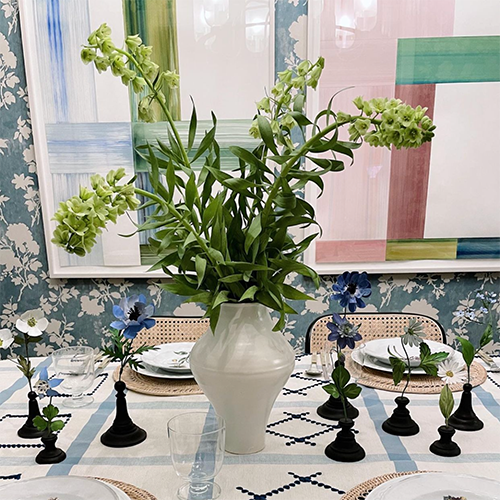
Kitchen Inspiration: Incorporating Pattern into a Practical Space with Wallpaper
Kitchen Inspiration: Incorporating Pattern into a Practical Space with Wallpaper
When moving in or renovating, it’s not uncommon for people to invest significantly more of that creative oomph into rooms that are more pleasurable than they are practical. We relax in our bedrooms, dining rooms, and living rooms and, for the most part, these are the spaces we target first with our paint brushes, wallpaper and fabric swatches, and best ideas.
The home office tends to be caught in between, while the bathrooms and, of course, the kitchen tend to get the tail-end of our attention. Yes, they can see the biggest transformation if you’re fitting a new kitchen or bath, but these are often the necessary and practical changes. Creativity can fall short when practicality is the name of the game.
But even the most functional of spaces deserve some beauty and, for that, wallpaper in the kitchen is one of our favourite options.
Combine wallpaper with tile for balance
A kitchen wallpapered from baseboard to ceiling can look great, but it can also be too similar to the way we use wallpaper in other downstairs rooms and, as a result, look too samey.
Just as you can divide a wall between panelling and wallpaper, however, you can also divide your wall between tiling (that kitchen-staple) and wallpaper. This is combining beauty with practicality in the most literal sense, protecting your wallpaper from most of the occupational hazards the kitchen presents, while also preventing the room from feeling too industrial.
Try to not be too rigid about colour matching your tiles to your wallpaper’s key colour – or the other way around – since, in all likelihood, you won’t be able to find a perfect match. Instead, pick out a minor colour from the wallpaper’s pattern – something used sparingly in areas of detail – and try to mirror that within your tile choice for an attractive contrast.
There are plenty of unique ways to use wallpaper, beyond the ‘usual’.
Zone a kitchen-diner with a pattern-paint contrast
A larger kitchen-diner is an excellent feature for a home to have. Unless you’re heavily into entertaining, closed-off dining rooms can easily get overlooked. It can feel a little too ceremonious to ‘prepare the dining room’ for a low-key mid-week dinner, whereas having that table at the other end of your kitchen helps to keep things feeling ready-for-purpose.
At the same time, creating some sense of separation is always worthwhile. It’s good to focus on tempering the utility of the kitchen with the leisure and ease of the dining area, and avoiding the sense that the table has just been ‘tacked onto’ the edge of the kitchen.
We talk a lot about zoning. In the past, we’ve written about zoning with lighting and rugs. One of our favourite ways to split up a room and create more than one purpose within it, however, is to zone with wallpaper.
Wallpapering one end of the room – not just a feature wall, but the two walls on either side of the dining area, too – is great for differentiating between these two areas without going so far as building a fourth wall.
Then again, when it comes to getting creative in the kitchen, utilising that ‘fifth wall’ could be exactly what you want to do…
Focus your attention on the ‘fifth wall’
Interior designers and decorators frequently refer to the ceiling as the fifth wall. While it has been overlooked in home design for a very long time (save for those regency favourites: cornices and ceiling roses), the colour and light wallpaper can bring to a space is being explored more and more on the ceiling, rather than the walls.
For most people, this will be sure to sound a little ‘out there’, but, in a room like the kitchen, a wallpapered ceiling makes a lot of sense. For starters, it’s safer from the occupational hazards of a room full of hot and cold splashes, grease, and steam but, beyond that, it makes use of what may well be the only wall not covered by appliances, cupboards, backsplashes, shelving, doorways, windows, and dressers.
A lot of people also find that deciding to paper ceiling gives them a little more freedom in terms of design, since the added distance makes it feel ‘safer’ to explore bolder patterns. Personally, we love the look of a twisting floral on the ceiling.
Your decorator will be able to work around any features like beams, and, if you’re keen to draw the eye up as much as possible, you can finish it off by installing an overhead pot hanger or vintage clothes airer.
More from Decoration